Why Retail Technology Works Best as Support, Not as a Replacement for Staff
Retail businesses today are rapidly adopting technology to improve operations, customer service, and overall profitability. From smart billing systems to inventory automation and workforce management tools, technology has become a major part of modern retail.
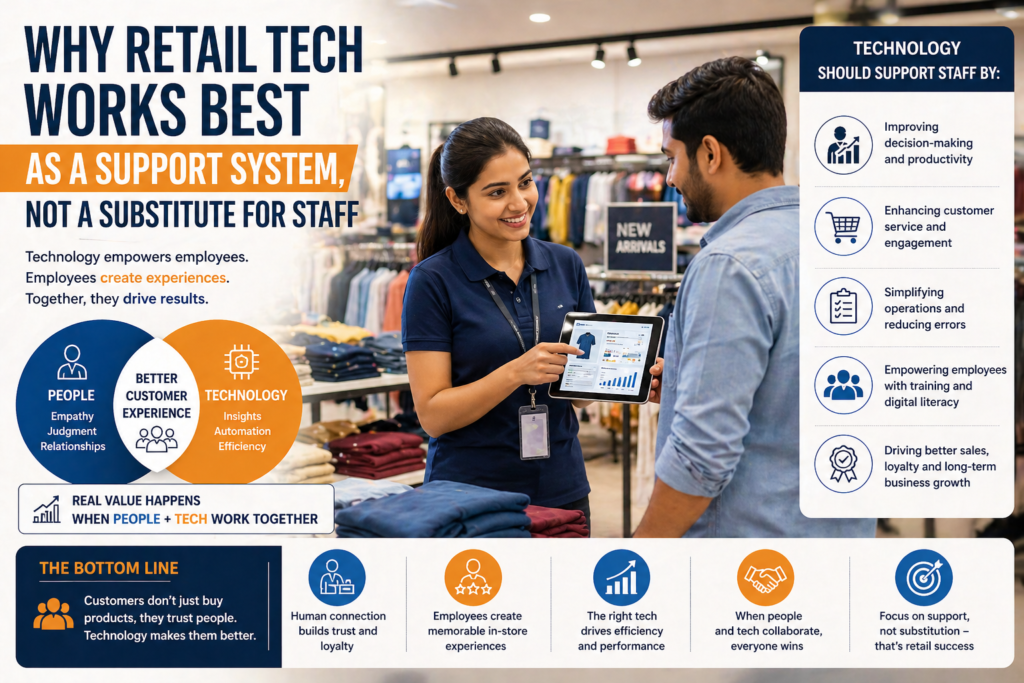
But one important truth remains clear: technology works best when it supports employees—not when it tries to replace them.
As highlighted in the original research discussion , retail success depends more on frontline staff than on software alone. The real value comes when technology helps employees deliver better customer experiences, improve store productivity, and increase sales efficiency.
Retail stores are built on human interaction, and no technology can fully replace that.
Technology Alone Does Not Create Retail Success
Many retail businesses make the mistake of believing that advanced software automatically leads to better performance.
In reality, the store staff create value—not the technology itself.
Technology can improve processes, but it cannot replace:
- Human judgment
- Customer relationships
- Personalized selling
- Trust-building conversations
- Real-time problem-solving
A customer often remembers helpful staff more than a billing machine.
That human connection is what drives repeat business.
Frontline Employees Are the Real Growth Drivers
Whether it is a supermarket, fashion outlet, electronics store, or luxury showroom, frontline employees play the biggest role in customer satisfaction.
They influence:
- Product recommendations
- Purchase decisions
- Basket size
- Customer retention
- Brand loyalty
When technology helps staff perform these roles better, the business grows faster.
But when technology creates complexity or replaces customer interaction, performance often suffers.
One Technology Solution Does Not Fit Every Retail Format
Every retail business operates differently.
A premium fashion store, a busy hypermarket, and a neighborhood grocery store all require different strategies.
Factors like:
- Customer traffic
- Store location
- Product pricing
- Staff dependency
- Customer expectations
- Labour intensity
all affect how technology should be used.
Copying systems used by global retailers without understanding local store realities often leads to higher costs and poor results.
Smart retail leaders focus on practical solutions, not expensive trends.
Technology Should Improve Human Decision-Making
The most successful retail technology does not replace employees—it improves their ability to make better decisions.
Examples include:
- Inventory systems that help staff know what is available
- Customer data that improves product recommendations
- Workforce tools that improve scheduling
- Training systems that strengthen assisted selling
- POS systems that reduce checkout delays
This allows employees to act as informed advisors instead of simple transaction processors.
That creates stronger customer trust.
Digital Literacy Matters More Than Software
Even the best technology fails if staff do not know how to use it properly.
Retail businesses must invest in:
- Employee training
- Digital literacy
- Simple user-friendly systems
- Strong supervision
- Peer learning culture
Technology adoption is not just about installation—it is about execution.
Without training, even expensive systems become barriers instead of business tools.
Premium Stores vs High-Traffic Stores
Different retail environments require different technology strategies.
In premium retail stores, data-driven recommendations often work better because customers expect personalized experiences.
In high-traffic stores like supermarkets or hypermarkets, staff guidance becomes more important because customers value speed and convenience.
Here, employees helping customers navigate crowded aisles can:
- Save shopping time
- Increase purchase size
- Improve customer satisfaction
- Build long-term loyalty
The goal should always be performance, not just automation.
Store Culture Also Impacts Technology Success
Retail performance depends on more than software.
Factors like:
- Store layout
- Hiring quality
- Leadership style
- Supervisor behavior
- Team collaboration
- Workplace learning culture
also decide whether technology helps or creates problems.
A strong store culture makes technology effective.
A weak store culture makes even the best systems fail.
Technology Should Reduce Friction, Not Add It
Many retail businesses invest heavily in systems that actually slow employees down.
Complicated dashboards, poor workflows, and unnecessary approvals often reduce productivity instead of improving it.
The best retail technology feels invisible—it quietly makes work easier without creating extra pressure.
If staff spend more time managing software than helping customers, the system is failing.
Final Thoughts
Retail technology should never replace people—it should empower them.
The strongest retail businesses understand that customers buy from people, not platforms.
Technology can improve efficiency, accuracy, and decision-making, but human interaction remains the foundation of successful retail.
Stores that combine smart systems with skilled frontline employees create better customer experiences, stronger loyalty, and higher profitability.
In retail, the future is not human vs technology.
It is human + technology working together.